
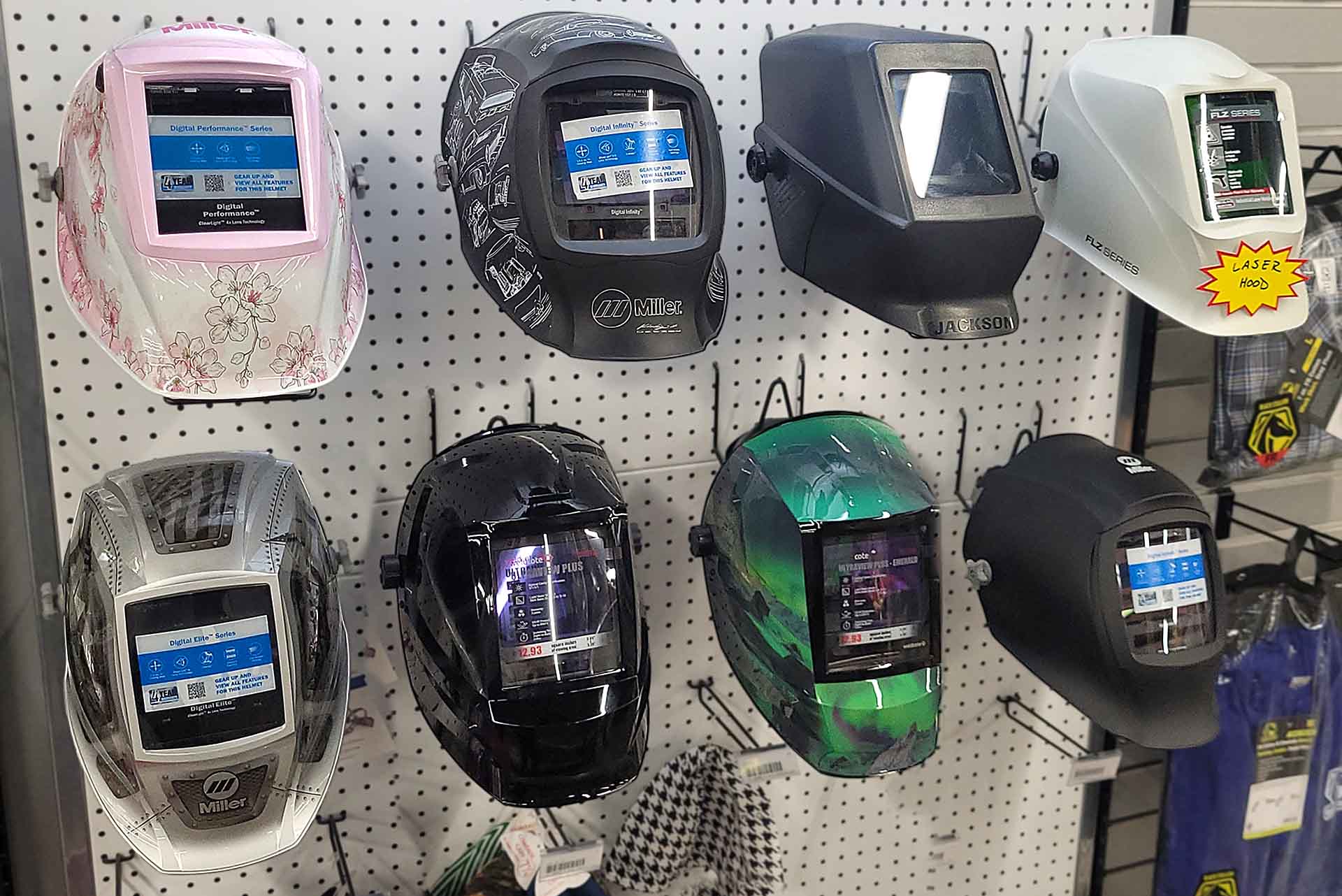
Walk into any welding supply shop and the helmet wall can stop you cold. Dozens of options, a price range that spans from $40 to $400 or more, and enough spec sheet language to make a straightforward purchase feel like an engineering decision. Auto-darkening or passive? Variable shade or fixed? What does optical class actually mean, and why does it cost more to get a better number?
This guide cuts through that. Whether you're buying your first helmet, or outfitting a crew with different processes and needs — the same framework applies. Know what the specs mean, match them to how you actually weld, and don't pay for features you won't use or skip the ones that matter.
The First Decision: Passive vs. Auto-Darkening
Every other buying consideration flows from this one.
Passive helmets use a fixed-shade lens — typically shade 10 — and no electronics. The welder positions the work, nods the helmet down to strike the arc, and lifts it back up to inspect. They're durable, reliable, and have no batteries to fail mid-shift. In a high-heat environment, in extreme cold, or in a shop where simplicity and cost matter most, a passive helmet is a completely legitimate choice. For a dedicated stick welder running the same process all day, a quality passive helmet does exactly what it needs to do.
Auto-darkening helmets (ADF) switch from a light viewing state — typically shade 3 or 4 — to the appropriate welding shade in a fraction of a second when the arc sensor detects a strike. The welder can see the joint, position the torch or electrode accurately, and strike the arc without having to nod down blind. For TIG welding, where arc placement is critical and repositioning is constant, the visibility advantage is significant. For welders running multiple processes or working in varied positions, it's the practical choice.
The switching speed of an auto-darkening helmet matters more than most buyers realize. ANSI Z87.1 requires a maximum switching speed of 1/25,000th of a second for compliant helmets. Budget auto-darkening helmets frequently do not meet this standard. A helmet that darkens slowly — even by a fraction of a millisecond — is exposing the welder's eyes to unfiltered arc radiation on every strike. This is one area where the price difference between a compliant helmet and a cheap one isn't about features. It's about protection.
Shade Range: Fixed vs. Variable
A fixed-shade helmet is set at one shade and stays there. A variable-shade helmet — standard on most auto-darkening models — allows the welder to dial the shade to match the process and amperage.
ANSI Z87.1 and OSHA standard 29 CFR 1910.252 provide shade guidance by process: MIG welding typically calls for shade 10–13, TIG for shade 8–13 depending on amperage, stick for shade 10–14, and plasma cutting for shade 8–10. A variable-shade helmet with a range of 5–13 covers the vast majority of shop applications with a single purchase — one helmet for the welder who MIGs structural steel in the morning and TIGs stainless in the afternoon.
Grind mode is a feature worth having on any multi-use helmet. It drops the lens to a light shade (typically 3–4) and disables the arc sensors, allowing the welder to keep the helmet down during grinding without the sensors triggering the darkening cycle. It's a small feature that solves a real frustration on the shop floor.
Optical Clarity: The Spec Most Buyers Skip
This is the spec that most directly affects weld quality and welder fatigue — and the one most frequently ignored at purchase.
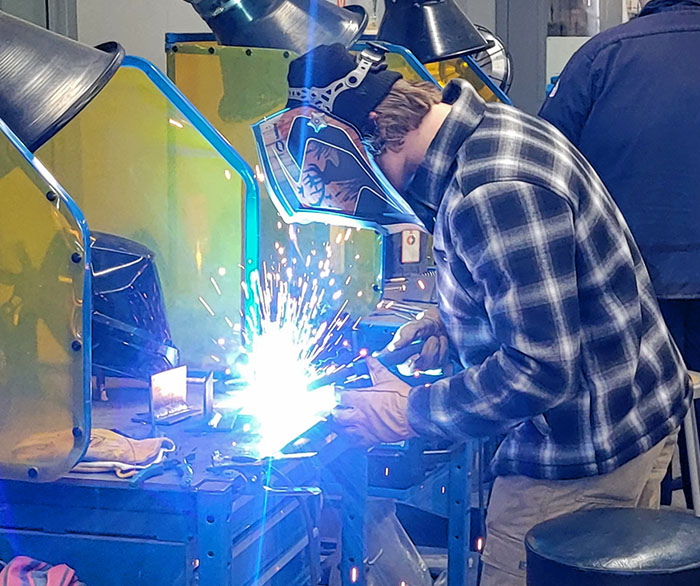
The EN379 optical class rating system uses four numbers to describe lens quality across optical clarity, diffusion of light, variation in luminous transmittance, and angle dependence of luminous transmittance. A rating of 1/1/1/1 is the highest available in each category. A helmet with a 1/1/1/1 optical rating delivers a clear, undistorted, color-accurate view of the weld pool from any angle.
Lower ratings — 1/2/3/2 is common in mid-range helmets, and worse ratings appear in budget options — introduce distortion, color shift, and inconsistency in how the lens performs as the viewing angle changes. For a welder doing flat-position MIG on mild steel all day, a lower optical class helmet may feel acceptable. For TIG welding, pipe welding, or any work requiring accurate weld pool reading, a low optical class lens introduces eye strain, makes it harder to read the puddle, and degrades weld quality over time.
A helmet rated 1/1/1/1 costs more than one rated 1/2/3/2. For a welder spending eight hours a day behind the lens, that difference pays back in reduced eye fatigue and better visibility of the work.
Viewing Area: Bigger Than You Think It Matters
Standard welding helmets offer a viewing area in the range of 9–10 square inches. Wide-view and panoramic helmets extend that significantly.
The practical difference is peripheral awareness. A larger viewing area means the welder can see more of the workpiece and surrounding area without repositioning. For structural welding, pipe work, out-of-position welding, or any application where spatial awareness matters, the wider field reduces repositioning and improves control. For production welding in a fixed flat position, a standard viewing area is typically sufficient.
Wider viewing area generally means a slightly heavier helmet. That tradeoff is worth evaluating based on how the helmet will actually be used.
Fit, Weight, and Comfort: The Specs That Determine Whether the Helmet Stays On
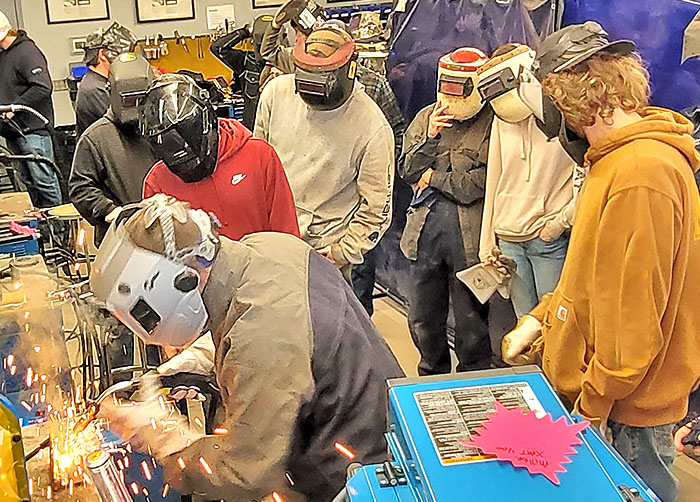
A helmet that causes neck fatigue, slips during positioning, or fits incorrectly doesn't get worn correctly. That's a protection failure, not a comfort preference.
Professional-grade welding helmets typically range from 18–26 oz. The difference is noticeable over a full shift, particularly for welders working in overhead or out-of-position situations where neck load compounds over time.
Headgear quality matters more than it sounds. Ratchet headgear allows quick one-handed size adjustment during the workday. Knob-style systems work but require more deliberate adjustment. Pivot points and range of motion affect how well the helmet sits across different working positions. A sweatband that's inadequate for an eight-hour shift in a warm shop is a detail that shows up in how consistently the helmet gets used. Hard hat compatibility is worth confirming for welders who work in construction or field environments.
Durability and Environment: Montana-Specific Considerations
Welding helmets operate in environments that most consumer electronics would not survive. Impact resistance, operating temperature range, and the quality of the shell and lens system all affect how a helmet holds up over a working lifespan.
Most professional-grade helmets specify operating temperature ranges for both storage and use. For Montana shops running in unheated buildings through January, or doing outdoor work in summer heat, those ranges matter. Auto-darkening electronics have performance thresholds — a helmet that switches reliably at 70°F may behave differently at 10°F. Check the operating temperature spec for any ADF helmet going into a cold-weather environment.
Sensitivity and delay controls deserve attention for specific applications. Sensitivity adjusts how easily the arc sensor triggers — relevant for low-amperage TIG work where cheap sensors misfire or fail to trigger. Delay controls how long the lens stays dark after the arc stops — relevant for stick welding where hot slag remains visible after the arc breaks. Both controls are standard on professional-grade helmets and absent or limited on budget options.
Replacement lens availability is a practical consideration that's easy to overlook at purchase. A helmet whose lenses are discontinued or require special ordering creates a maintenance problem down the road. Sticking with established brands means replacement lenses and parts remain available throughout the helmet's working life.
Matching the Helmet to the Process
Pulling the above together into practical guidance:
For TIG welding: prioritize optical clarity (1/1/1/1 rating), a fast-reacting ADF with variable shade (8–13), and lighter weight for precision positioning.
For MIG welding: a variable-shade ADF covering shade 10–13 handles most applications. Optical class 1/1/1/2 or better. Grind mode is useful.
For stick welding: a passive helmet at shade 10–14 is a legitimate option for dedicated stick welders. If the welder also runs other processes, step up to a variable-shade ADF.
For multi-process shops: a variable-shade ADF with a wide viewing area and strong optical class rating covers the broadest range of applications.
For field and construction welding: hard hat compatibility, wide operating temperature range, and impact resistance are the priorities.
Try It Before You Commit
Spec sheets tell you what a helmet can do. Putting one on tells you whether it works for the welder wearing it. Fit, balance, headgear feel, and the quality of the view through the lens are things that show up in use, not on paper.
General Distributing gives customers the opportunity to evaluate welding equipment before committing — including helmets. Our team across six Montana branch locations can walk through the buying decision based on your specific processes, environment, and crew. If you're outfitting multiple welders with different needs, that conversation is worth having in person rather than working through a product page.
Stop by your nearest branch, give us a call, or reach out through Ask Our Experts. We carry Miller Electric, ESAB, Jackson Safety, Honeywell, Weldcote, and more — and we're happy to help you find the right fit.
Subscribe to Gendco Happenings — our biweekly newsletter — to stay connected with what's happening across our six Montana branches.
Walk into any welding supply shop and the helmet wall can stop you cold. Dozens of options, a price range that spans from $40 to $400 or more, and enough spec sheet language to make a straightforward purchase feel like an engineering decision. Auto-darkening or passive? Variable shade or fixed? What does optical class actually mean, and why does it cost more to get a better number?
This guide cuts through that. Whether you're buying your first helmet, or outfitting a crew with different processes and needs — the same framework applies. Know what the specs mean, match them to how you actually weld, and don't pay for features you won't use or skip the ones that matter.
The First Decision: Passive vs. Auto-Darkening
Every other buying consideration flows from this one.
Passive helmets use a fixed-shade lens — typically shade 10 — and no electronics. The welder positions the work, nods the helmet down to strike the arc, and lifts it back up to inspect. They're durable, reliable, and have no batteries to fail mid-shift. In a high-heat environment, in extreme cold, or in a shop where simplicity and cost matter most, a passive helmet is a completely legitimate choice. For a dedicated stick welder running the same process all day, a quality passive helmet does exactly what it needs to do.
Auto-darkening helmets (ADF) switch from a light viewing state — typically shade 3 or 4 — to the appropriate welding shade in a fraction of a second when the arc sensor detects a strike. The welder can see the joint, position the torch or electrode accurately, and strike the arc without having to nod down blind. For TIG welding, where arc placement is critical and repositioning is constant, the visibility advantage is significant. For welders running multiple processes or working in varied positions, it's the practical choice.
The switching speed of an auto-darkening helmet matters more than most buyers realize. ANSI Z87.1 requires a maximum switching speed of 1/25,000th of a second for compliant helmets. Budget auto-darkening helmets frequently do not meet this standard. A helmet that darkens slowly — even by a fraction of a millisecond — is exposing the welder's eyes to unfiltered arc radiation on every strike. This is one area where the price difference between a compliant helmet and a cheap one isn't about features. It's about protection.
Shade Range: Fixed vs. Variable
A fixed-shade helmet is set at one shade and stays there. A variable-shade helmet — standard on most auto-darkening models — allows the welder to dial the shade to match the process and amperage.
ANSI Z87.1 and OSHA standard 29 CFR 1910.252 provide shade guidance by process: MIG welding typically calls for shade 10–13, TIG for shade 8–13 depending on amperage, stick for shade 10–14, and plasma cutting for shade 8–10. A variable-shade helmet with a range of 5–13 covers the vast majority of shop applications with a single purchase — one helmet for the welder who MIGs structural steel in the morning and TIGs stainless in the afternoon.
Grind mode is a feature worth having on any multi-use helmet. It drops the lens to a light shade (typically 3–4) and disables the arc sensors, allowing the welder to keep the helmet down during grinding without the sensors triggering the darkening cycle. It's a small feature that solves a real frustration on the shop floor.
Optical Clarity: The Spec Most Buyers Skip
This is the spec that most directly affects weld quality and welder fatigue — and the one most frequently ignored at purchase.
The EN379 optical class rating system uses four numbers to describe lens quality across optical clarity, diffusion of light, variation in luminous transmittance, and angle dependence of luminous transmittance. A rating of 1/1/1/1 is the highest available in each category. A helmet with a 1/1/1/1 optical rating delivers a clear, undistorted, color-accurate view of the weld pool from any angle.
Lower ratings — 1/2/3/2 is common in mid-range helmets, and worse ratings appear in budget options — introduce distortion, color shift, and inconsistency in how the lens performs as the viewing angle changes. For a welder doing flat-position MIG on mild steel all day, a lower optical class helmet may feel acceptable. For TIG welding, pipe welding, or any work requiring accurate weld pool reading, a low optical class lens introduces eye strain, makes it harder to read the puddle, and degrades weld quality over time.
A helmet rated 1/1/1/1 costs more than one rated 1/2/3/2. For a welder spending eight hours a day behind the lens, that difference pays back in reduced eye fatigue and better visibility of the work.
Viewing Area: Bigger Than You Think It Matters
Standard welding helmets offer a viewing area in the range of 9–10 square inches. Wide-view and panoramic helmets extend that significantly.
The practical difference is peripheral awareness. A larger viewing area means the welder can see more of the workpiece and surrounding area without repositioning. For structural welding, pipe work, out-of-position welding, or any application where spatial awareness matters, the wider field reduces repositioning and improves control. For production welding in a fixed flat position, a standard viewing area is typically sufficient.
Wider viewing area generally means a slightly heavier helmet. That tradeoff is worth evaluating based on how the helmet will actually be used.
Fit, Weight, and Comfort: The Specs That Determine Whether the Helmet Stays On
A helmet that causes neck fatigue, slips during positioning, or fits incorrectly doesn't get worn correctly. That's a protection failure, not a comfort preference.
Professional-grade welding helmets typically range from 18–26 oz. The difference is noticeable over a full shift, particularly for welders working in overhead or out-of-position situations where neck load compounds over time.
Headgear quality matters more than it sounds. Ratchet headgear allows quick one-handed size adjustment during the workday. Knob-style systems work but require more deliberate adjustment. Pivot points and range of motion affect how well the helmet sits across different working positions. A sweatband that's inadequate for an eight-hour shift in a warm shop is a detail that shows up in how consistently the helmet gets used. Hard hat compatibility is worth confirming for welders who work in construction or field environments.
Durability and Environment: Montana-Specific Considerations
Welding helmets operate in environments that most consumer electronics would not survive. Impact resistance, operating temperature range, and the quality of the shell and lens system all affect how a helmet holds up over a working lifespan.
Most professional-grade helmets specify operating temperature ranges for both storage and use. For Montana shops running in unheated buildings through January, or doing outdoor work in summer heat, those ranges matter. Auto-darkening electronics have performance thresholds — a helmet that switches reliably at 70°F may behave differently at 10°F. Check the operating temperature spec for any ADF helmet going into a cold-weather environment.
Sensitivity and delay controls deserve attention for specific applications. Sensitivity adjusts how easily the arc sensor triggers — relevant for low-amperage TIG work where cheap sensors misfire or fail to trigger. Delay controls how long the lens stays dark after the arc stops — relevant for stick welding where hot slag remains visible after the arc breaks. Both controls are standard on professional-grade helmets and absent or limited on budget options.
Replacement lens availability is a practical consideration that's easy to overlook at purchase. A helmet whose lenses are discontinued or require special ordering creates a maintenance problem down the road. Sticking with established brands means replacement lenses and parts remain available throughout the helmet's working life.
Matching the Helmet to the Process
Pulling the above together into practical guidance:
For TIG welding: prioritize optical clarity (1/1/1/1 rating), a fast-reacting ADF with variable shade (8–13), and lighter weight for precision positioning.
For MIG welding: a variable-shade ADF covering shade 10–13 handles most applications. Optical class 1/1/1/2 or better. Grind mode is useful.
For stick welding: a passive helmet at shade 10–14 is a legitimate option for dedicated stick welders. If the welder also runs other processes, step up to a variable-shade ADF.
For multi-process shops: a variable-shade ADF with a wide viewing area and strong optical class rating covers the broadest range of applications.
For field and construction welding: hard hat compatibility, wide operating temperature range, and impact resistance are the priorities.
Try It Before You Commit
Spec sheets tell you what a helmet can do. Putting one on tells you whether it works for the welder wearing it. Fit, balance, headgear feel, and the quality of the view through the lens are things that show up in use, not on paper.
General Distributing gives customers the opportunity to evaluate welding equipment before committing — including helmets. Our team across six Montana branch locations can walk through the buying decision based on your specific processes, environment, and crew. If you're outfitting multiple welders with different needs, that conversation is worth having in person rather than working through a product page.
Stop by your nearest branch, give us a call, or reach out through Ask Our Experts. We carry Miller Electric, ESAB, Jackson Safety, Honeywell, Weldcote, and more — and we're happy to help you find the right fit.