
Personal Protective Equipment (PPE) for Welders: A Head-to-Toe Checklist for Montana Shops
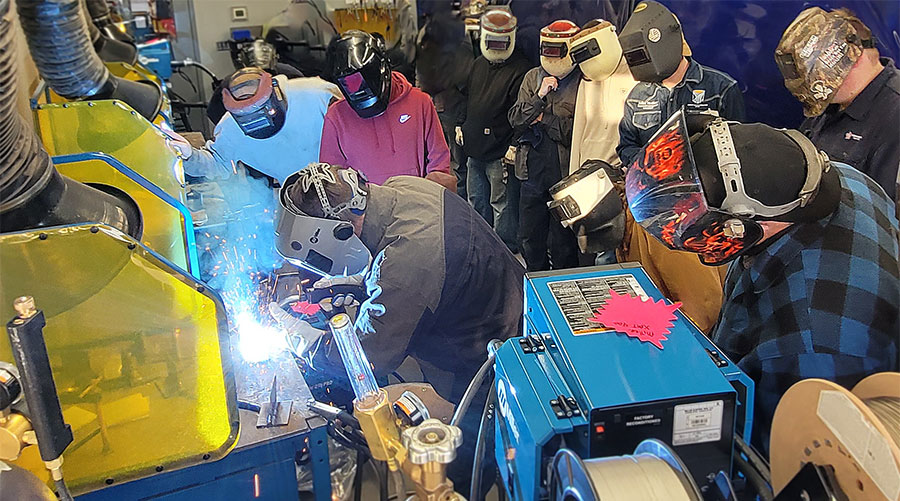
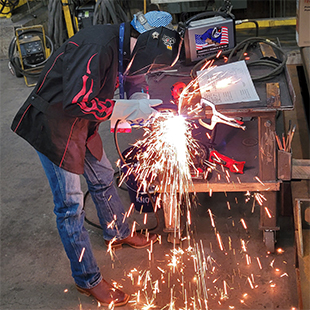
Think about what actually happens the moment a welder strikes an arc. UV and infrared radiation intense enough to cause permanent eye damage in seconds. Spatter reaching temperatures above 2,500°F, landing on fire retardant fabric, footwear and potentially on exposed skin. Fumes rising from the weld pool carrying compounds that, without protection, accumulate in lung tissue over years. Noise levels in an enclosed shop that exceed safe thresholds before the first hour of the shift is done.
Welding PPE isn't a formality. It's a system, and every piece of it is doing something specific. When the system is complete, a welder can do their job safely through a full shift. When it has gaps, those gaps have consequences that range from a burn today to a long-term health condition that shows up years later.
This is a head-to-toe welding PPE checklist built for Montana shops — practical, process-specific, and designed to be useful whether you're outfitting a new hire or reviewing what your crew is already wearing.
Head and Face: Helmets, Eye Protection, and Hearing
Welding Helmets
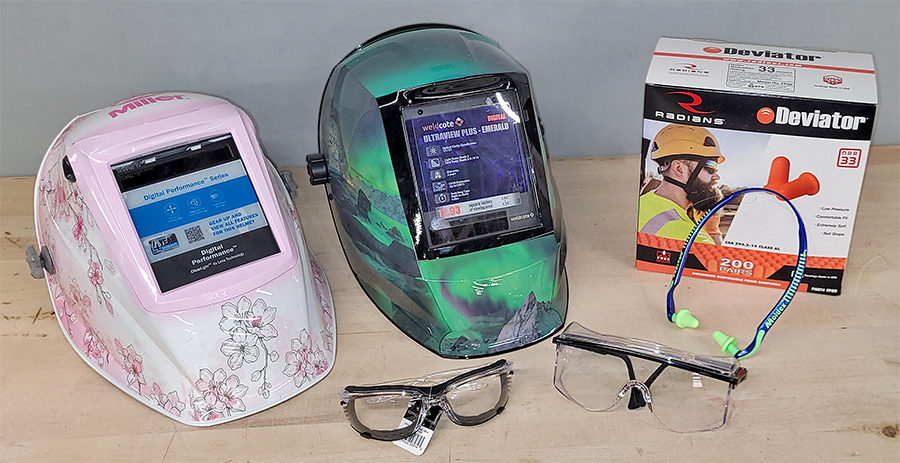
The welding helmet is the most visible piece of PPE on the shop floor, and it's also the one with the most variation in quality and fit. The two primary types are passive lenses and auto-darkening filters (ADFs).
Passive lenses are fixed at a single shade, typically shade 10 for most MIG and stick welding, and require the welder to nod the helmet down before striking an arc. They're durable, reliable, and have no batteries to fail. Auto-darkening helmets switch from a light state to the appropriate shade in milliseconds when the arc is struck, allowing the welder to position themselves accurately before the arc starts. For production welding or precision TIG work, that visibility advantage is significant.
Shade requirements vary by process and amperage. MIG welding typically calls for shade 10–13, TIG for shade 8–13 depending on amperage, and plasma cutting for shade 8–10. Using an insufficient shade is one of the most common and easily preventable causes of arc eye.
“Arc eye, also called welder's flash (or photokeratitis), is a UV burn on the surface of the eye. It's acutely painful, temporarily debilitating, and entirely preventable. It can result from a single unprotected exposure to an arc. Secondary exposure from a nearby welder is a common and underappreciated risk in shops with multiple welding stations.”
Helmet fit matters more than most buyers account for. A helmet that shifts during positioning, sits too far from the face, or causes neck fatigue on long shifts is a helmet that will be pushed up or set aside. Weight, headgear adjustment, and viewing area size are worth evaluating before purchase, not after.
Eye Protection Under the Helmet
Safety glasses are not optional under a welding helmet, they're the backup layer when the helmet is lifted for repositioning, grinding, or inspection. Flying debris, grinding sparks, and UV arc flash don't wait for the helmet to come back down. Side-shield rated safety glasses meeting ANSI Z87.1 are the standard. For grinding operations, a full-face shield over safety glasses provides appropriate coverage.
Hearing Protection
Welding environments routinely exceed 85 decibels, enclosed shops, plasma cutting operations, and grinding push those levels significantly higher. Hearing protection is crucial to help prevent hearing loss from occupational noise exposure, which is permanent, cumulative, and one of the most commonly underreported workplace injuries in the trades.
Disposable foam earplugs with an appropriate noise reduction rating (NRR) are the most common solution and work well when inserted correctly, which most workers don’t do without instruction. Earmuffs are easier to use consistently and appropriate for intermittent exposure. For welders working extended shifts in high-noise environments, a combination of both provides the highest protection.
Respiratory Protection: The Most Underestimated Category
Welding fume exposure is one of the most significant long-term health risks in the trade, and one of the categories most frequently addressed with inadequate controls, and insufficient respiratory protection.
Welding fumes are not a single substance. Their composition depends on the base metal, filler material, coatings, and process being used. Mild steel welding fumes commonly contain iron oxides and manganese. Stainless steel welding can generate hexavalent chromium and nickel-containing fumes, which present serious health hazards, including cancer risks. Welding galvanized steel can produce zinc oxide fumes, which can cause metal fume fever following acute exposure. Other coatings and finishes can release additional hazardous compounds when heated, creating both short- and long-term health risks depending on the material and level of exposure.
OSHA establishes permissible exposure limits (PELs) for many of the hazardous substances found in welding fumes, with specific requirements for certain contaminants such as hexavalent chromium. When welding stainless steel, coated metals, or other materials that generate hazardous fumes, ventilation may not always be sufficient to keep exposure within applicable limits, making proper exposure assessment and additional controls essential.
General ventilation, such as shop airflow and mechanical ventilation, can help reduce welding fume concentrations, but may not adequately control exposure in the welder's breathing zone. Local exhaust ventilation (LEV), positioned as close as practical to the weld, captures fumes at the source before they reach the breathing zone. When ventilation and other engineering controls cannot adequately control exposure, an appropriate respirator may also be required.
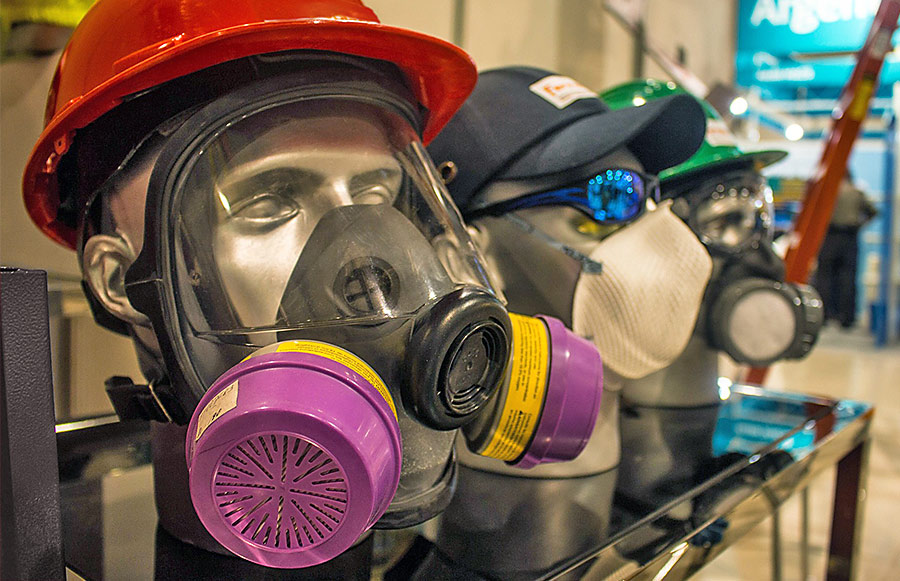
For most mild steel welding with adequate local exhaust ventilation, a half-face respirator with combination OV/P100 cartridges provides appropriate protection. For stainless, coated metals, or confined space welding, a powered air-purifying respirator (PAPR) should be considered.
A respirator that does not fit correctly provides no meaningful protection, and fit testing is not a one-time event. Fit testing is important because the respirator only provides its intended protection if the facepiece forms an adequate seal against the wearer’s face. Tight-fitting respirators must be fit tested before initial workplace use, at least annually thereafter, and whenever changes to the respirator or wearer could affect the seal. A user seal check should also be performed every time the respirator is put on.
Montana-specific note: many Montana shops operate in older facilities with limited ventilation infrastructure. In these environments, respiratory protection moves from a supplemental control to an essential one. If your shop has welders working in spaces where fume visibly accumulates, that is not a ventilation situation, it's a respirator situation.
Upper Body: Jackets, Gloves, and Aprons
Welding Jackets and Sleeves
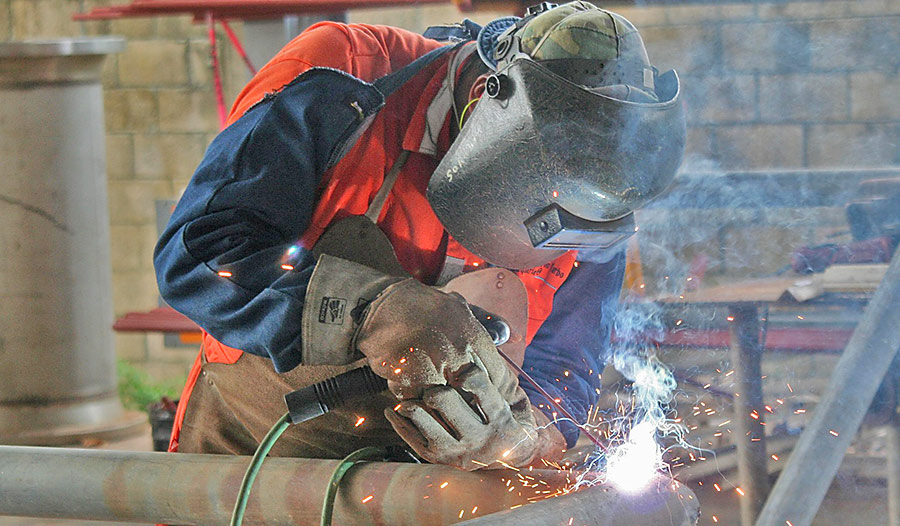
The primary function of upper-body PPE in a welding environment is to protect the welder from sparks and spatter, heat, and radiation from the welding arc. The material and level of protection should be matched to the welding process and the hazards of the specific job.
Leather jackets provide excellent protection against heat, sparks, and spatter, making them well suited to demanding welding applications and jobs that generate significant spatter. Cowhide and split-leather garments are common choices, with different weights, cuts, and grades offering different levels of durability, comfort, and mobility. Split leather is lighter and more flexible, full-grain generally provides greater durability.
Flame-resistant (FR) cotton provides a lighter, more breathable alternative and can be appropriate for applications where sparks and spatter are relatively mild. That can make it more comfortable during long shifts or hot summer conditions, but it does not provide the same level of protection as heavier leather garments in applications involving intense heat and spatter.
Ordinary clothing should not be mistaken for welding PPE. Untreated cotton and denim can ignite and burn, while synthetic fabrics such as polyester and nylon can melt when exposed to intense heat, and the burning material can adhere to the skin. Clothing should be selected based on the hazards of the welding operation and the employer's PPE assessment.
Welding sleeves can provide additional arm protection when a full welding jacket is not necessary. As with any welding PPE, they should provide adequate coverage for the actual exposure and be selected according to the welding process, position, and amount of heat, sparks, and spatter involved.
Welding Gloves
Glove selection depends on the process. Heavy leather MIG and stick gloves provide maximum spatter and heat protection but limit dexterity. TIG welding gloves are lighter and more fitted, designed for the precision manipulation that TIG work requires. Cut-resistant gloves are appropriate for handling sheet metal and sharp materials before and after welding.
"The most common glove mistake is using heavy stick gloves for TIG work, the welder loses the tactile feedback the process requires and compensates with poor technique. The second most common mistake is continuing to use gloves that are worn through, cracked, or have been wet. A compromised glove is not a functional piece of PPE. Replace them."
Leather Aprons
For welding positions where the chest and lap are directly in the line of spatter, flat position welding, foundry work, heavy fabrication, a leather apron adds a layer of protection over the jacket and pants. In high-spatter environments, it extends the life of the clothing underneath and provides an additional thermal barrier.
Lower Body and Footwear
Pants
The lower body is frequently the least protected part of a welder's kit, and the reasoning is usually comfort or cost. Neither justifies the exposure.
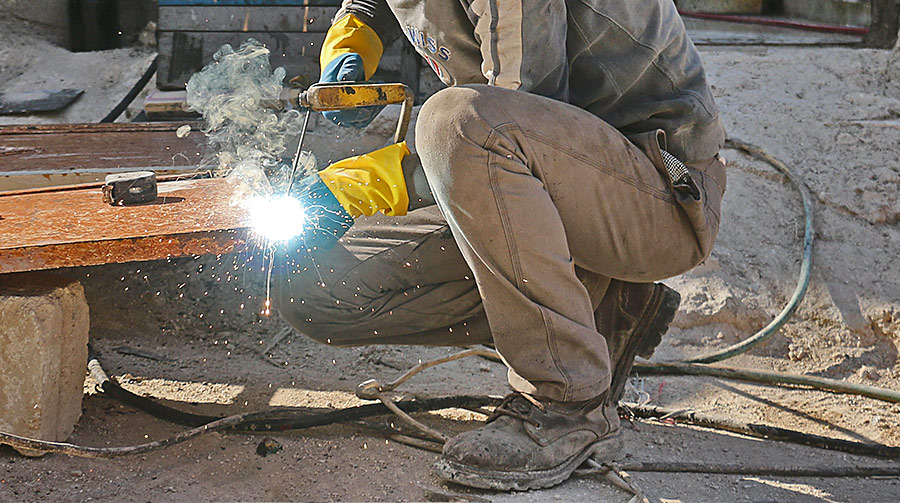
Synthetic fabrics, including nylon, polyester, and most blended workwear, are not appropriate for welding environments. As with upper body protection, they melt on contact. FR cotton or wool are the appropriate materials for welding pants. Denim provides moderate protection in low-spatter applications but is not FR rated and should not be treated as equivalent.
Pants should be cuffless or worn without cuffs rolled up. Cuffs collect spatter and hot metal debris, a common and entirely preventable source of lower leg burns. Pants should be worn over the top of boots, not tucked in, for the same reason.
Footwear
Steel-toed leather boots are the baseline standard for welding environments. The leather upper is critical, mesh panels, canvas, or synthetic materials that allow spatter penetration and are not appropriate for the shop floor. Boot height matters: low-cut boots leave the ankle exposed in any environment where spatter or molten metal is present.
Metatarsal guards, either built into the footwear or worn externally, are appropriate where workers face significant impact hazards from falling or rolling materials. A standard safety toe protects the toes, but it does not provide the same protection to the metatarsal area on top of the foot. In shops handling heavy steel and other materials, metatarsal protection provides important additional coverage.
Pay attention to laces. Traditional woven laces can catch spatter and smolder or ignite before the welder notices. Leather laces or lace covers reduce this risk. Pull-on boots eliminate it entirely for welders who prefer them.
PPE as a System
PPE works as a system, not as individual pieces. A properly rated welding helmet does not make up for inadequate clothing or missing gloves. Likewise, a leather jacket and FR pants do not address respiratory hazards when welding stainless steel if respiratory protection is required. Effective protection means looking at the welder from head to toe and making sure the PPE matches the hazards of the job.
Shop culture matters just as much as the equipment. Even the best PPE provides little value if it stays on a hook because it is uncomfortable, fits poorly, or isn't consistently used. A strong safety culture starts with PPE that fits the people wearing it and leadership that sets the example by following the same standards expected of the crew.
If the PPE in your shop is the gear that came with the job ten years ago and nobody has reviewed it since, that's worth addressing. Processes change, crews change, and the standards for what constitutes adequate protection have continued to develop.
Outfitting Your Shop: Where GD Comes In
General Distributing carries PPE and safety supplies across all the categories covered in this post, including FR apparel, welding helmets, gloves, and respiratory protection from some of the most trusted names in welding safety. We supply shops across Montana from six branch locations: Great Falls, Billings, Bozeman, Butte, Helena, and Glendive.
John Foster, GD's in-house safety specialist, is available for shops that want to review their current PPE setup or work through what their specific processes and environments actually require. That's not a sales conversation — it's a professional one. If your shop is running stainless steel and your crew is using the same respiratory protection they use for mild steel, that's something worth knowing before it becomes a health issue.
GD also offers on-site safety training for shops that want to make sure their entire crew is working with the most current safety guidelines. Getting the gear right is step one, making sure everyone knows how to use it correctly is step two.
Stop by your nearest branch, give us a call, or reach out through Ask Our Experts. We're here.
Subscribe to Gendco Happenings — our biweekly newsletter — to stay connected with what's happening across our six Montana branches.
Think about what actually happens the moment a welder strikes an arc. UV and infrared radiation intense enough to cause permanent eye damage in seconds. Spatter reaching temperatures above 2,500°F, landing on fire retardant fabric, footwear and potentially on exposed skin. Fumes rising from the weld pool carrying compounds that, without protection, accumulate in lung tissue over years. Noise levels in an enclosed shop that exceed safe thresholds before the first hour of the shift is done.
Welding PPE isn't a formality. It's a system, and every piece of it is doing something specific. When the system is complete, a welder can do their job safely through a full shift. When it has gaps, those gaps have consequences that range from a burn today to a long-term health condition that shows up years later.
This is a head-to-toe welding PPE checklist built for Montana shops — practical, process-specific, and designed to be useful whether you're outfitting a new hire or reviewing what your crew is already wearing.
Head and Face: Helmets, Eye Protection, and Hearing
Welding Helmets
The welding helmet is the most visible piece of PPE on the shop floor, and it's also the one with the most variation in quality and fit. The two primary types are passive lenses and auto-darkening filters (ADFs).
Passive lenses are fixed at a single shade, typically shade 10 for most MIG and stick welding, and require the welder to nod the helmet down before striking an arc. They're durable, reliable, and have no batteries to fail. Auto-darkening helmets switch from a light state to the appropriate shade in milliseconds when the arc is struck, allowing the welder to position themselves accurately before the arc starts. For production welding or precision TIG work, that visibility advantage is significant.
Shade requirements vary by process and amperage. MIG welding typically calls for shade 10–13, TIG for shade 8–13 depending on amperage, and plasma cutting for shade 8–10. Using an insufficient shade is one of the most common and easily preventable causes of arc eye.
“Arc eye, also called welder's flash (or photokeratitis), is a UV burn on the surface of the eye. It's acutely painful, temporarily debilitating, and entirely preventable. It can result from a single unprotected exposure to an arc. Secondary exposure from a nearby welder is a common and underappreciated risk in shops with multiple welding stations.”
Helmet fit matters more than most buyers account for. A helmet that shifts during positioning, sits too far from the face, or causes neck fatigue on long shifts is a helmet that will be pushed up or set aside. Weight, headgear adjustment, and viewing area size are worth evaluating before purchase, not after.
Eye Protection Under the Helmet
Safety glasses are not optional under a welding helmet, they're the backup layer when the helmet is lifted for repositioning, grinding, or inspection. Flying debris, grinding sparks, and UV arc flash don't wait for the helmet to come back down. Side-shield rated safety glasses meeting ANSI Z87.1 are the standard. For grinding operations, a full-face shield over safety glasses provides appropriate coverage.
Hearing Protection
Welding environments routinely exceed 85 decibels, enclosed shops, plasma cutting operations, and grinding push those levels significantly higher. Hearing protection is crucial to help prevent hearing loss from occupational noise exposure, which is permanent, cumulative, and one of the most commonly underreported workplace injuries in the trades.
Disposable foam earplugs with an appropriate noise reduction rating (NRR) are the most common solution and work well when inserted correctly, which most workers don’t do without instruction. Earmuffs are easier to use consistently and appropriate for intermittent exposure. For welders working extended shifts in high-noise environments, a combination of both provides the highest protection.
Respiratory Protection: The Most Underestimated Category
Welding fume exposure is one of the most significant long-term health risks in the trade, and one of the categories most frequently addressed with inadequate controls, and insufficient respiratory protection.
Welding fumes are not a single substance. Their composition depends on the base metal, filler material, coatings, and process being used. Mild steel welding fumes commonly contain iron oxides and manganese. Stainless steel welding can generate hexavalent chromium and nickel-containing fumes, which present serious health hazards, including cancer risks. Welding galvanized steel can produce zinc oxide fumes, which can cause metal fume fever following acute exposure. Other coatings and finishes can release additional hazardous compounds when heated, creating both short- and long-term health risks depending on the material and level of exposure.
OSHA establishes permissible exposure limits (PELs) for many of the hazardous substances found in welding fumes, with specific requirements for certain contaminants such as hexavalent chromium. When welding stainless steel, coated metals, or other materials that generate hazardous fumes, ventilation may not always be sufficient to keep exposure within applicable limits, making proper exposure assessment and additional controls essential.
General ventilation, such as shop airflow and mechanical ventilation, can help reduce welding fume concentrations, but may not adequately control exposure in the welder's breathing zone. Local exhaust ventilation (LEV), positioned as close as practical to the weld, captures fumes at the source before they reach the breathing zone. When ventilation and other engineering controls cannot adequately control exposure, an appropriate respirator may also be required.
For most mild steel welding with adequate local exhaust ventilation, a half-face respirator with combination OV/P100 cartridges provides appropriate protection. For stainless, coated metals, or confined space welding, a powered air-purifying respirator (PAPR) should be considered.
A respirator that does not fit correctly provides no meaningful protection, and fit testing is not a one-time event. Fit testing is important because the respirator only provides its intended protection if the facepiece forms an adequate seal against the wearer’s face. Tight-fitting respirators must be fit tested before initial workplace use, at least annually thereafter, and whenever changes to the respirator or wearer could affect the seal. A user seal check should also be performed every time the respirator is put on.
Montana-specific note: many Montana shops operate in older facilities with limited ventilation infrastructure. In these environments, respiratory protection moves from a supplemental control to an essential one. If your shop has welders working in spaces where fume visibly accumulates, that is not a ventilation situation, it's a respirator situation.
Upper Body: Jackets, Gloves, and Aprons
Welding Jackets and Sleeves
The primary function of upper-body PPE in a welding environment is to protect the welder from sparks and spatter, heat, and radiation from the welding arc. The material and level of protection should be matched to the welding process and the hazards of the specific job.
Leather jackets provide excellent protection against heat, sparks, and spatter, making them well suited to demanding welding applications and jobs that generate significant spatter. Cowhide and split-leather garments are common choices, with different weights, cuts, and grades offering different levels of durability, comfort, and mobility. Split leather is lighter and more flexible, full-grain generally provides greater durability.
Flame-resistant (FR) cotton provides a lighter, more breathable alternative and can be appropriate for applications where sparks and spatter are relatively mild. That can make it more comfortable during long shifts or hot summer conditions, but it does not provide the same level of protection as heavier leather garments in applications involving intense heat and spatter.
Ordinary clothing should not be mistaken for welding PPE. Untreated cotton and denim can ignite and burn, while synthetic fabrics such as polyester and nylon can melt when exposed to intense heat, and the burning material can adhere to the skin. Clothing should be selected based on the hazards of the welding operation and the employer's PPE assessment.
Welding sleeves can provide additional arm protection when a full welding jacket is not necessary. As with any welding PPE, they should provide adequate coverage for the actual exposure and be selected according to the welding process, position, and amount of heat, sparks, and spatter involved.
Welding Gloves
Glove selection depends on the process. Heavy leather MIG and stick gloves provide maximum spatter and heat protection but limit dexterity. TIG welding gloves are lighter and more fitted, designed for the precision manipulation that TIG work requires. Cut-resistant gloves are appropriate for handling sheet metal and sharp materials before and after welding.
"The most common glove mistake is using heavy stick gloves for TIG work, the welder loses the tactile feedback the process requires and compensates with poor technique. The second most common mistake is continuing to use gloves that are worn through, cracked, or have been wet. A compromised glove is not a functional piece of PPE. Replace them."
Leather Aprons
For welding positions where the chest and lap are directly in the line of spatter, flat position welding, foundry work, heavy fabrication, a leather apron adds a layer of protection over the jacket and pants. In high-spatter environments, it extends the life of the clothing underneath and provides an additional thermal barrier.
Lower Body and Footwear
Pants
The lower body is frequently the least protected part of a welder's kit, and the reasoning is usually comfort or cost. Neither justifies the exposure.
Synthetic fabrics, including nylon, polyester, and most blended workwear, are not appropriate for welding environments. As with upper body protection, they melt on contact. FR cotton or wool are the appropriate materials for welding pants. Denim provides moderate protection in low-spatter applications but is not FR rated and should not be treated as equivalent.
Pants should be cuffless or worn without cuffs rolled up. Cuffs collect spatter and hot metal debris, a common and entirely preventable source of lower leg burns. Pants should be worn over the top of boots, not tucked in, for the same reason.
Footwear
Steel-toed leather boots are the baseline standard for welding environments. The leather upper is critical, mesh panels, canvas, or synthetic materials that allow spatter penetration and are not appropriate for the shop floor. Boot height matters: low-cut boots leave the ankle exposed in any environment where spatter or molten metal is present.
Metatarsal guards, either built into the footwear or worn externally, are appropriate where workers face significant impact hazards from falling or rolling materials. A standard safety toe protects the toes, but it does not provide the same protection to the metatarsal area on top of the foot. In shops handling heavy steel and other materials, metatarsal protection provides important additional coverage.
Pay attention to laces. Traditional woven laces can catch spatter and smolder or ignite before the welder notices. Leather laces or lace covers reduce this risk. Pull-on boots eliminate it entirely for welders who prefer them.
PPE as a System
PPE works as a system, not as individual pieces. A properly rated welding helmet does not make up for inadequate clothing or missing gloves. Likewise, a leather jacket and FR pants do not address respiratory hazards when welding stainless steel if respiratory protection is required. Effective protection means looking at the welder from head to toe and making sure the PPE matches the hazards of the job.
Shop culture matters just as much as the equipment. Even the best PPE provides little value if it stays on a hook because it is uncomfortable, fits poorly, or isn't consistently used. A strong safety culture starts with PPE that fits the people wearing it and leadership that sets the example by following the same standards expected of the crew.
If the PPE in your shop is the gear that came with the job ten years ago and nobody has reviewed it since, that's worth addressing. Processes change, crews change, and the standards for what constitutes adequate protection have continued to develop.
Outfitting Your Shop: Where GD Comes In
General Distributing carries PPE and safety supplies across all the categories covered in this post, including FR apparel, welding helmets, gloves, and respiratory protection from some of the most trusted names in welding safety. We supply shops across Montana from six branch locations: Great Falls, Billings, Bozeman, Butte, Helena, and Glendive.
John Foster, GD's in-house safety specialist, is available for shops that want to review their current PPE setup or work through what their specific processes and environments actually require. That's not a sales conversation — it's a professional one. If your shop is running stainless steel and your crew is using the same respiratory protection they use for mild steel, that's something worth knowing before it becomes a health issue.
GD also offers on-site safety training for shops that want to make sure their entire crew is working with the most current safety guidelines. Getting the gear right is step one, making sure everyone knows how to use it correctly is step two.
Stop by your nearest branch, give us a call, or reach out through Ask Our Experts. We're here.